Free delivery to Sweden in 2–5 business daysFast and reliable shipping with tracking included.
Complete your wall
We've sent you an email with a link to update your password.
Reset your password
We will send you an email to reset your password.
August Offer
—
What Size Wall Art Do You Need? A Room-by-Room Guide
Belora & Co
0 comments
The most common question in wall art is also the one most guides answer badly: what size should I actually buy? The advice usually defaults to vague rules — "go bigger than you think" — without giving a method for arriving at a number. This is a more direct approach: a room-by-room, wall-by-wall method for choosing the right size, with no guesswork required.
The rule that matters most: measure the wall, not the room
The single biggest sizing mistake is choosing art based on the room's overall scale rather than the specific wall or furniture grouping it will sit above or beside. A large living room with a modestly sized sofa does not automatically call for an oversized print — the print needs to relate to what is directly around it, not to the room as a whole.
The reliable method: measure the width of the furniture or wall section the art will be placed above, then choose art that covers roughly 60–75% of that width. Above a sofa, above a console table, above a headboard — the same ratio applies. A piece that is too narrow relative to the furniture looks stranded. A piece that exceeds the furniture width on both sides starts to overwhelm it.
Living room: the primary wall
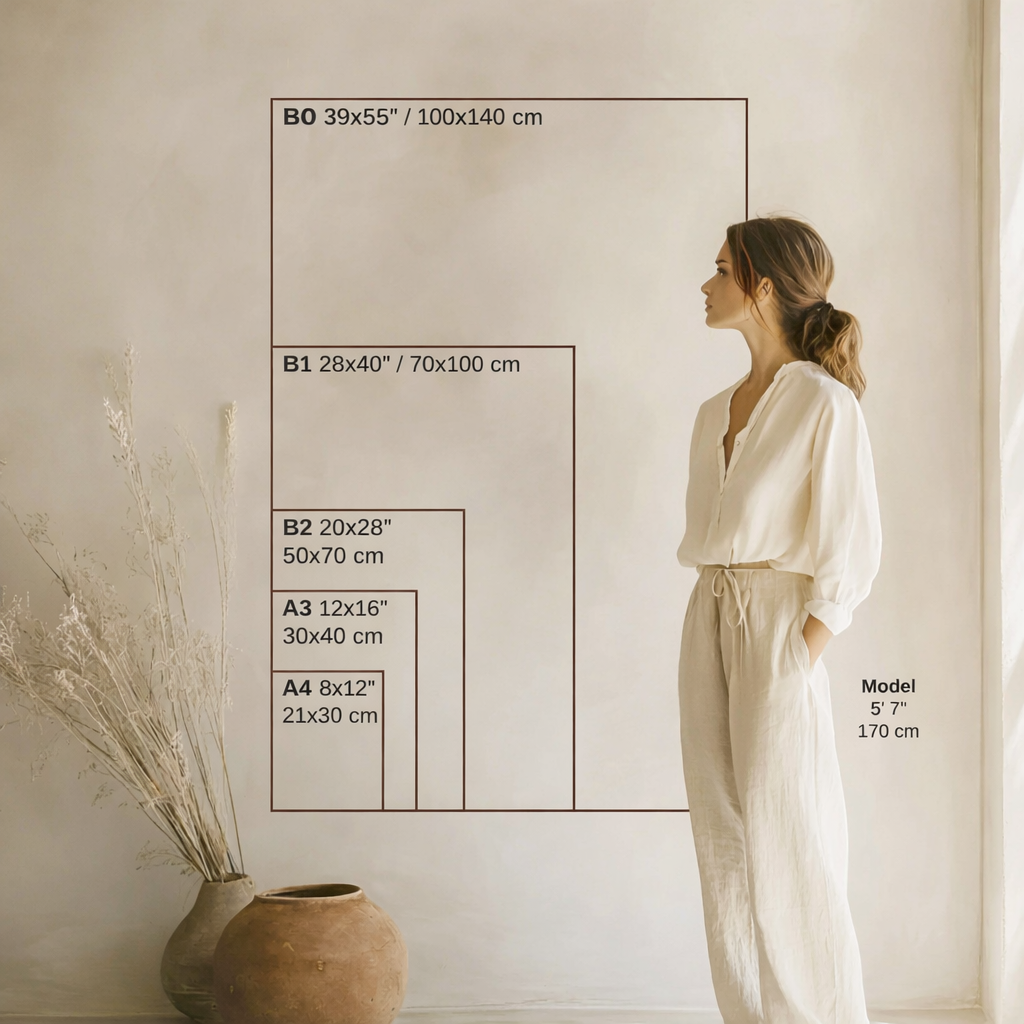
For a living room's main wall — typically above a sofa or the focal wall opposite the seating area — the standard three-seat sofa (roughly 200–220 cm wide) pairs well with a single piece at 70×100 cm. This size reads as a genuine focal point without needing a second or third piece to fill the space.
For a smaller wall or a two-seat sofa, 50×70 cm is usually the better fit — still substantial, but proportional to a more contained space.
For an especially large wall — double-height ceilings, a wall wider than 300 cm with no furniture directly beneath it — the 100×140 cm format is worth considering. At this size, a single piece can genuinely anchor a room on its own, without needing additional elements to feel complete.
Bedroom: two different walls, two different answers
The wall above a queen or king headboard (roughly 150–180 cm wide) works well with a 70×100 cm piece, centred. This is large enough to read as intentional without needing to span the full headboard width.
The wall opposite the bed — which matters more in daily use than the headboard wall — should be sized to the wall itself rather than to the bed. If it is a full, unbroken wall, 70×100 cm or larger is appropriate. If the wall is narrower or interrupted by a window or wardrobe, 50×70 cm keeps the piece proportional to the available space.
Dining room and hallway
A dining room wall, if there is one clear focal wall, generally suits the same 70×100 cm range as a living room — dining rooms are seen primarily while seated, at a slight distance, which favours a size with enough presence to read clearly from the table.
Hallways and narrower walls are the one context where smaller formats genuinely work well. A 30×40 cm or A4 print, or a tighter grouping of two or three pieces at that scale, suits a hallway's typically narrower wall width and the fact that it is viewed at closer range while passing through.
Study, home office, and smaller rooms
A home office or study wall, viewed primarily while seated at a desk, works well at 50×70 cm for a single-wall focal piece, or A4 to 30×40 cm for a piece positioned closer to eye level within a smaller field of view, such as directly behind or beside a desk.
What happens when you size too small
Undersized art is by a wide margin the most common sizing error, and it is worth understanding exactly what goes wrong. A print that is too small for its wall does not simply look modest — it reads as unfinished, as though a larger piece was intended but never arrived. The eye registers the gap between the art and the edges of the wall or furniture as absence rather than as breathing room.
This is why the instinct toward caution — choosing a smaller size to be safe — usually produces a worse result than committing to the size the wall actually calls for. When genuinely unsure between two sizes, the larger one is almost always the better choice.
Framed or unframed, and how that affects sizing
Framing adds visual weight without changing the print dimensions, which means a framed piece can read slightly larger than the same print unframed. For walls at the borderline between two sizes, choosing framed can help a smaller format hold the wall more convincingly — useful in cases where the next size up would be a stretch for the space or budget.
Framed formats are available up to 50×70 cm. For anything larger, an unframed print mounted with a simple hanging system, or framed locally, is the practical route.
Quick reference
A4 (21×30 cm): hallway groupings, desk-height study walls, narrow spaces.
30×40 cm: hallway focal points, small study or office walls, secondary bedroom walls.
70×100 cm: standard living room sofa wall, bedroom headboard and opposite walls, dining room focal wall.
100×140 cm: large or double-height walls, statement pieces with no furniture reference point.
The practical takeaway
Measure the specific wall or furniture width first. Aim for 60–75% of that measurement. When between two sizes, size up rather than down. This method removes the guesswork that makes wall art sizing feel harder than it needs to be.
The full range of sizes is available across the old money wall art, Riviera, alpine, and Palm Beach collections, framed or unframed, with free worldwide shipping. For the broader question of how to choose the right image once size is settled, the guide to choosing art for a living room covers that decision in detail.
The art looks spectacular ❤️. Ordered 3 pieces in 2 different sizes with black wooden frames. The quality is fantastic and it looks very expensive. Real show stoppers!