Cart
0
Free delivery to Sweden in 2–5 business days
Fast and reliable shipping with tracking included.


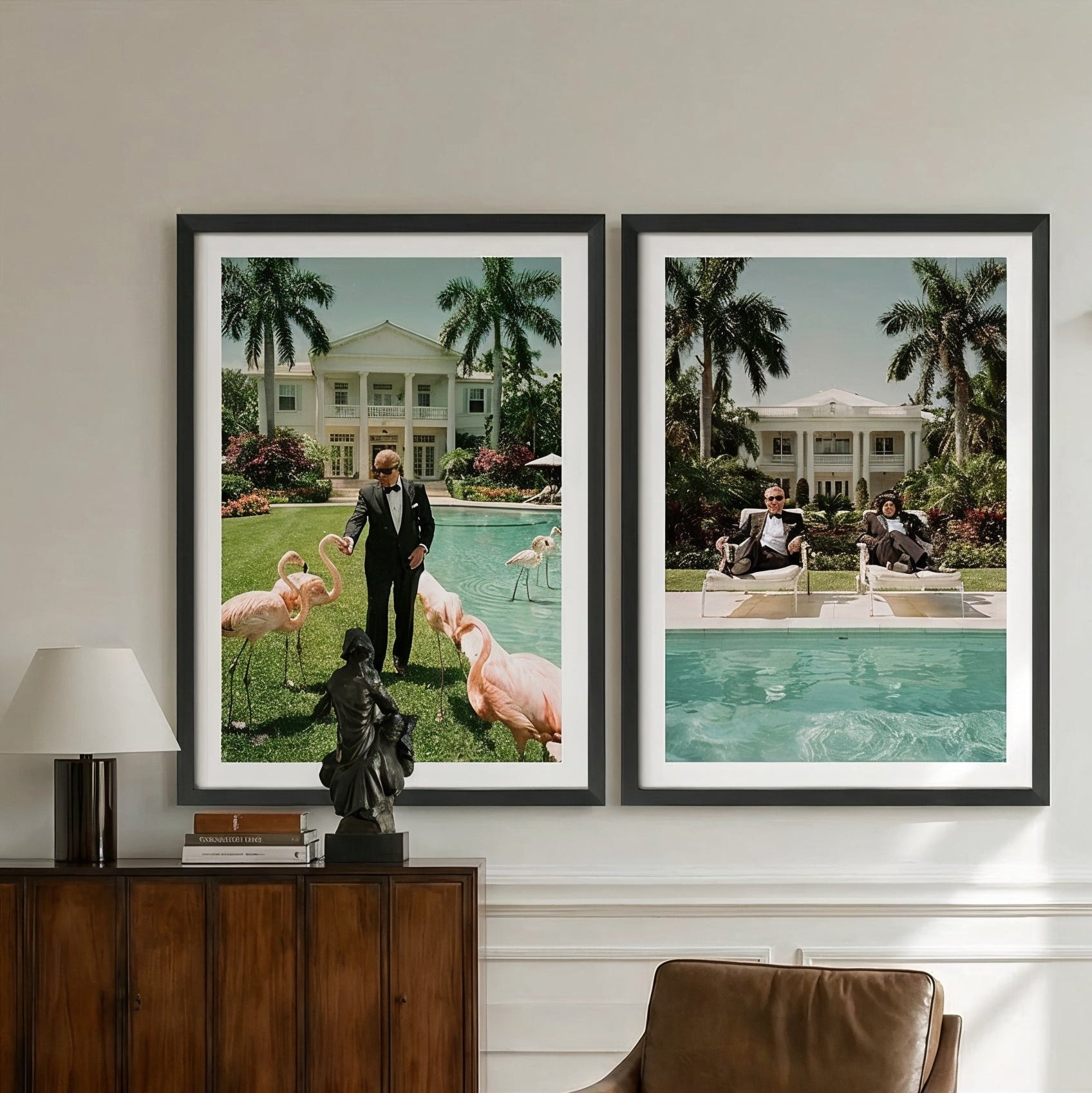
Slim Aarons had a formula, and he was the first to admit it. He wanted to photograph, in his own words, "attractive people doing attractive things in attractive places." For nearly five decades — from the late 1940s through the 1990s — he did exactly that, producing a body of work that became the defining visual record of mid-century luxury.
Palm Springs pool parties. Gstaad ski slopes. The French Riviera in high summer. Palm Beach in season. His subjects were socialites, film stars, industrialists, and aristocrats — photographed not on sets or in studios, but in their own homes, on their own terms, in the clothes they actually wore and the settings they actually inhabited. No artificial lighting. No stylists. Just Aarons, his camera, and an extraordinary access to a world most people only glimpsed from a distance.
The result was something no fashion photographer of the era produced: images that felt genuinely lived-in. The glamour was real because the people in it were real. And that authenticity is precisely why the work has never dated.

Several qualities distinguish a Slim Aarons photograph from the aspirational imagery that came before and after it.
Composure. Aarons' subjects never perform for the camera. They are never caught mid-laugh, never turning to face the lens with a posed smile. They are simply present — in the scene, in the moment, entirely at ease. The composure communicates something that cannot be faked: these people are not trying to project wealth. They are living it.
Colour. The Kodachrome palette of Aarons' colour work is immediately recognisable — warm, saturated, slightly overexposed in the way that Kodachrome film rendered sunlight. The aquamarine of a pool against terracotta tiles. The green of alpine pasture against grey sky. The warm sand tones of Palm Beach in January. These are colours that exist in real life, but that film rendered with a quality that digital photography has never quite matched.
Setting as subject. In a Slim Aarons photograph, the location is never merely a backdrop. The architecture of a Palm Springs villa, the terraces of a Riviera hotel, the snow-covered landscape of Gstaad — these carry as much narrative weight as the people in front of them. The setting tells you where you are in the social geography of mid-century wealth. The person tells you how to feel about it.
Ironic distance. The best Aarons images contain a quality of self-awareness that elevates them beyond documentation. The subject knows they are being photographed. The photograph knows it is about more than the subject. There is a slight absurdity — a man in black tie on a ski slope, a woman reading a newspaper by a pool, a group of socialites on inflatables — that the image never acknowledges and never explains. This is the quality that makes the work endlessly reproducible as a cultural reference.

The Slim Aarons archive is owned by Getty Images and licensed exclusively through a small number of authorised sellers. Official estate-stamped prints start at several hundred pounds for open editions and climb steeply for limited and collector editions. A certified limited-edition print from the archive can reach five figures.
For most people furnishing a home — even a well-considered, design-literate home — this is simply not the relevant price point. The demand for the aesthetic, without the barrier of the archive price, is what has driven the market for Slim Aarons inspired prints.
The inspired print market is large and uneven. Most of it produces imagery that borrows the surface qualities of Aarons' work — pool scenes, luxury settings, aspirational subjects — without understanding the underlying grammar. The result is imagery that looks like a mood board rather than a photograph. It has the right elements but none of the authority.
The qualities that distinguish a genuinely Aarons-inspired print from a decorative approximation are the same qualities that made the original work iconic.
Composure in the subject. The person in the image should not be smiling, waving, or engaging with the camera. They should be present and entirely unbothered. The moment the subject performs for the camera, the image loses its authority. Aarons' subjects looked through the camera, never at it.
Photographic authenticity. The best inspired prints feel like genuine photographs — not illustrations, not digital composites with visible seams, not styled product shots. The lighting should be naturalistic. The colours should feel like film rather than screen. The grain and warmth of Kodachrome is the reference point for colour work; for black and white, the tonal depth of large-format film.
Setting with cultural weight. The location should say something. A generic pool could be anywhere. A pool with the right architecture, the right furniture, the right light — that is a specific world. The Riviera, Palm Beach, the Swiss Alps, the Hamptons. The best inspired prints place their subjects in locations that carry the cultural memory of mid-century luxury, not just its visual surface.
The right tension. The most memorable Aarons images contain a slight incongruity — something slightly wrong in a scene that is otherwise completely composed. It is never played for comedy. It is simply present. A print that achieves this quality has understood the work at a deeper level than surface imitation.

The entire Belora & Co catalogue is built around the Slim Aarons visual grammar — aspirational subjects, specific geographies, total composure, and the slight ironic distance that elevates documentation into art.
The Palm Beach collection is the most direct expression of the aesthetic — pool scenes, coastal glamour, figures in luxury settings who are entirely unbothered by their surroundings. The Riviera collection reaches for the Côte d'Azur, where Aarons spent significant time during the 1960s and 1970s. The Alpine collection covers the other great Aarons territory — Gstaad, St. Moritz, the Swiss winter world of après-ski and private chalets.
The prints are produced on archival giclée paper with fade-resistant inks — a production standard that holds the tonal depth and colour warmth that the aesthetic requires. On matte paper, the warm palette of a pool scene or a Riviera terrace reads with the same quality that Kodachrome film once delivered. Without glare. Without the flatness of a screen.
Available unframed from A4 to 100×140 cm, and framed from A4 to 50×70 cm. Free worldwide shipping.
Slim Aarons documented a world that no longer exists in the form he photographed it. The social season at Palm Beach has changed. Gstaad is different. The French Riviera is more crowded and less private than it was in 1965.
But the feeling that his photographs produced — the sense of a life lived with ease, in beautiful places, with complete composure — has never stopped being compelling. It is why the work is reproduced on every mood board for every luxury interior project. It is why the aesthetic has outlasted every trend that has tried to replace it.
The right inspired print carries that feeling into a room. Not as nostalgia. As a point of view.
Explore Belora's full collection of Slim Aarons inspired prints — Palm Beach, Riviera, Alpine, and old money wall art.


