Free delivery to Sweden in 2–5 business daysFast and reliable shipping with tracking included.
Complete your wall
We've sent you an email with a link to update your password.
Reset your password
We will send you an email to reset your password.
August Offer
—
The Riviera, At Home — Old-Money Glamour Without the Performance
Sebastian Plengier
0 comments
Long before "quiet luxury" had a name, the French Riviera was already living it.
From the 1950s through the late 1970s, a very particular kind of elegance took hold along that stretch of coast — unhurried, unbranded, faintly amused by anyone trying too hard. It was never about the size of the villa or the price of the watch. It was about knowing exactly where to sit, who to nod to, and when to say nothing at all.
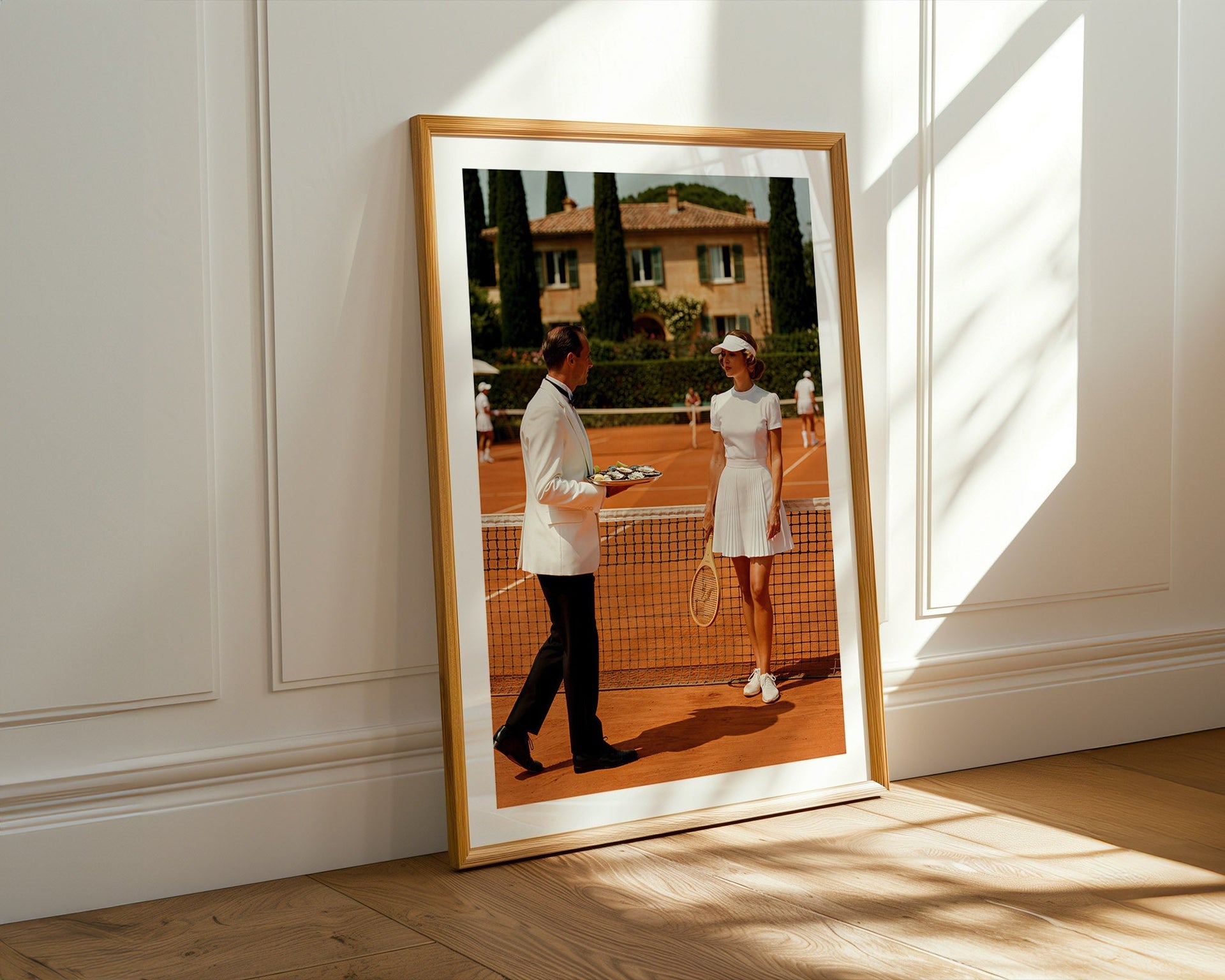
It's the world photographers like Slim Aarons spent entire careers documenting: linen shirts worn loose, a convertible left running outside a café nobody thought to photograph because there was no audience to perform for, lunch that began at noon and simply never found a reason to end. The Riviera wasn't a holiday. It was a posture.
What the Riviera Look Actually Looked Like
Strip away the postcards and the look has very specific ingredients: sun-bleached stone, deep shade, a palette of cream, cobalt and tan leather. Nothing matched on purpose, and everything matched anyway. The people in these photographs rarely smile for the camera — they're mid-conversation, mid-cigarette, mid-thought, entirely unconcerned with being seen. That composure is the whole point. It's what separates a Riviera photograph from a holiday snapshot: the subject isn't performing relaxation. They simply have it.
This is also, not coincidentally, what separates wall art that holds a room from wall art that merely decorates it.
Why the Look Still Works in a Living Room Today
Sixty years on, most interiors have the opposite problem: too much, trying too hard. A wall crowded with five mismatched frames says "I was buying things." One large, well-chosen print of a scene that radiates ease says something else entirely.
It's the same instinct behind what we think of as the old money aesthetic more broadly — restraint as a form of confidence, rather than absence as a form of minimalism. The Riviera is simply where that instinct first got photographed properly.
Bringing the Riviera Home
A Riviera print earns its place on a wall the way the original scene earned its place on a terrace: not shouting for attention, just being correct. A few ways it tends to work best:
Above a console or sideboard in an entryway, where it's the first thing a guest sees and the only thing that needs to be.
Paired with linen, oak and brass rather than anything glossy or branded — the print should feel like it belongs to the room, not like it was hung to impress whoever walks in.
Sized generously. A 50×70cm or larger reads as a considered statement; anything smaller tends to disappear into the wall rather than anchor it.
Two from the collection worth a closer look: View Over the French Riviera, for the room that wants a single calm focal point, and Porsche 911 Riviera Sunset, for anyone whose idea of restraint still has a little speed in it.
Explore the Collection
The full Riviera collection is built around exactly that tension — sun, speed, and la dolce vita, printed on museum-quality archival paper and shipped worldwide. No two prints in it perform the same scene twice, and none of them are trying particularly hard to get your attention. That's rather the point.
The art looks spectacular ❤️. Ordered 3 pieces in 2 different sizes with black wooden frames. The quality is fantastic and it looks very expensive. Real show stoppers!