Cart
0
Free delivery to Sweden in 2–5 business days
Fast and reliable shipping with tracking included.


Alpine and glamour do not appear to belong together. Alpine suggests cold, practical, physical — wool sweaters, wooden beams, the smell of pine. Glamour suggests warmth, excess, ease. The two aesthetics appear to occupy opposite ends of the same spectrum.
And yet for a very particular period — roughly the 1960s through the 1980s — the Swiss and Austrian Alps became the most glamorous places in Europe. Not despite the cold. Because of it. The discomfort of altitude and temperature was the point. It separated those who could afford to be there from those who could not. It gave the setting a quality that the Riviera and Palm Beach, available to anyone with a flight and a hotel room, no longer had: exclusivity.
Gstaad. St. Moritz. Verbier. Cortina d'Ampezzo. These were not ski resorts in the conventional sense. They were social seasons staged at altitude. The skiing was incidental. The parties, the people, and the particular combination of luxury and wilderness — that was the point.
The alpine glamour aesthetic is the visual and cultural legacy of that world.

The alpine glamour aesthetic is not ski-chalet cosiness. That is a separate register entirely — hygge at altitude, focused on warmth, texture, and retreat. Alpine glamour is something harder and more specific.
It is a woman in a fur coat on a snow-covered terrace, holding a glass of something that is not hot chocolate. It is a Porsche parked in front of a chalet that has been in the family for three generations. It is a man in a dinner jacket crossing a mountain landscape with a silver tray — absurd in the setting, completely unbothered by the incongruity. It is the intersection of formality and wilderness, of European luxury and Alpine severity.
The colour palette reflects this tension. The warm tones of the chalet interior — dark wood, amber light, aged leather — against the monochrome severity of the landscape outside. Many of the most compelling alpine glamour images are black and white precisely because the palette of the Alps in winter — grey sky, white snow, dark pines — is already close to monochrome. The removal of colour intensifies rather than reduces the atmosphere.
The Belora Alpine collection is built entirely around this register. Not the cosy chalet aesthetic of hygge-adjacent winter interiors. The harder, more specific world of alpine glamour — aspirational, slightly ironic, and entirely composed.

To understand alpine glamour, it helps to understand the social geography that produced it.
Gstaad, in the Bernese Oberland of Switzerland, became the defining resort of the aesthetic. From the 1950s onward, it attracted a specific kind of wealth — European aristocracy, American industrialists, film stars with a taste for privacy, and the particular hybrid of old and new money that characterised mid-century luxury. The Palace Hotel became the social centre. The skiing was good. The privacy was better.
St. Moritz was older, more established, and arguably more prestigious — the resort that had existed long enough to have a mythology of its own. Cortina d'Ampezzo brought Italian style into the equation: the same altitude, the same luxury, the same social season, but with a Mediterranean looseness that Gstaad's Swiss formality never quite permitted.
What these places shared was a quality that very few locations in the world have managed to sustain: genuine inaccessibility. Not the manufactured exclusivity of a members club or a VIP section. The real inaccessibility of altitude, cold, and a social world that had been operating on its own terms for long enough to have its own logic.
The alpine glamour aesthetic translates into interior design through contrast — the same tension between warmth and severity that defines the landscape itself.
Dark walnut and aged pine against white walls. Heavy wool and aged leather against clean architectural lines. The warmth of amber lighting against the grey-blue tones visible through large windows. These are rooms that take the outside seriously rather than shutting it out — rooms that acknowledge the mountain rather than retreating from it.
Art plays a specific role in this aesthetic. Generic mountain photography — scenic, documentary, focused on landscape rather than human presence — misses the point entirely. The alpine glamour interior requires art that carries the social and cultural weight of the aesthetic, not merely its geography. A photograph of a mountain is a landscape. A photograph of someone on a mountain — composed, at ease, entirely unbothered by their surroundings — is an attitude.
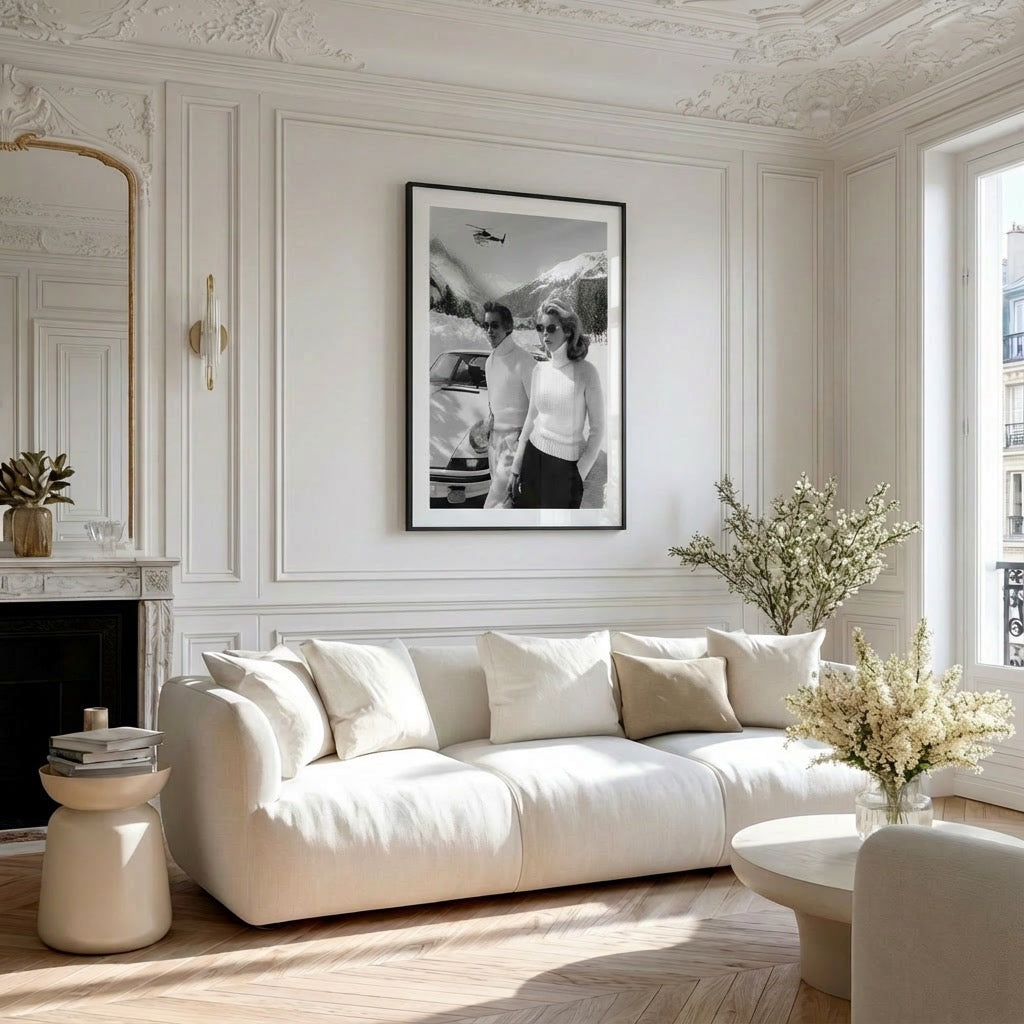
This is precisely the logic behind the Belora Alpine collection. The prints are not landscapes. They are character studies staged in a landscape. 1980s Jetsetter in Gstaad — a fur coat, a private jet, the Graubünden mountains. Vintage Waiter in Gstaad — a dinner jacket, a silver tray, a snow-covered mountain road. Alpine Escape — a couple beside a car with a helicopter in the background, as though transport at this altitude was simply a matter of preference.
These images carry the cultural memory of the alpine glamour world into a room. They do not explain themselves. They do not require explanation.

For rooms built around the alpine glamour aesthetic, the selection principle is the same one that governed the original social world: composure over performance, specificity over generality, a point of view over decoration.
The strongest alpine glamour prints share several qualities. The subject should be human — or at least carry the trace of human presence. Pure landscape, however beautiful, lacks the social register that the aesthetic requires. The setting should be specific enough to place the image in a recognisable world — the Alps, not merely mountains. And the subject, wherever they are in the frame, should be entirely at ease.
In black and white, the alpine glamour aesthetic achieves its most resolved form. The monochrome palette matches the severity of the landscape. The tonal depth of a well-produced print on archival matte paper captures the quality of light at altitude — clean, cold, and slightly overexposed — better than colour can.
For rooms with warmer tones, the colour prints in the Alpine collection provide the contrast the aesthetic requires — warm subjects in a cold landscape, the tension between interior luxury and exterior severity made visible on the wall.
The alpine glamour aesthetic shares a visual grammar with two other worlds that defined the same era of European luxury: the French Riviera and the American east coast.
The Riviera collection is the summer equivalent — the same social world relocated to Monaco, Nice, and Cannes for the warmer months. The same composure, the same cultural weight, the same ironic distance. Alpine and Riviera prints work together in a gallery arrangement precisely because they reference the same world from different seasons.
The Palm Beach collection extends the geography to the American coast — a different climate, a different social register, but the same fundamental attitude. A wall that combines Alpine, Riviera, and Palm Beach prints is not a travel gallery. It is a portrait of a particular way of moving through the world.
All prints are produced on archival giclée paper with fade-resistant inks — the production standard used in museum editions. Available unframed from A4 to 100×140 cm, and framed from A4 to 50×70 cm. Free worldwide shipping.

The alpine glamour aesthetic references a world that existed briefly and specifically — a few decades, a handful of resorts, a social season that required both money and a particular kind of ease to access. It was not democratic. It was not supposed to be.
But the feeling it produced — the sense of altitude and luxury held in tension, of formality maintained in the most impractical of settings, of total composure in a landscape that demands anything but — has never stopped being compelling.
A room that carries that feeling does not need to explain where it came from. It simply has it.
Explore the full Alpine collection at Belora & Co — and browse related collections: Riviera, Palm Beach, and black and white prints.


